Home · Book Reports · 2025
Practice
2025-10-19
The key (to anything really) is to stick with it and every day do something that advances your project specifically or your craft generally. Doing this should help to get you into a flow-like state where it becomes habit and you simply "do the work" every day without really thinking about it. The author argues that there is no such writer's block (but this could be applied to any creative endevour) and a lack of daily practice is what keeps people from getting things done; if you don't feel inspired, write anyway, write junk, throw it out, keep writing. "We don't write because we feel like it, we feel like it because we write." With all this practice every day taking up a large chunk of your life, one should recognize that if you are planning to become great at your craft, understand there will be a sacrifice - you can't do everything.
Creative Act
2025-10-09
Apparently Rick Rubin is a music producer, and while he certainly makes use of some art as music examples there are plenty of other media he explores with his examples and musings. Some of the advice given is quite literal in how you might go about whittling your work down or finding ways to see the works (or world) through a different lens. Other advice is more abstract, but useful none-the-less, and helps you find, start, or complete a project when you are stuck. I think his advice on treating every project as nothing more than an experiment, that you can discard at a moment's notice like a child dropping one toy for another, helps to alleviate stress about it being good enough and simultaneously allowing even failures to be seen as experimental stepping stones that will make the next project that much better. Finally another important take-away is the idea that you can train for anything - that obviously means the technical aspect of your craft, but it also means you can train yourself to quiet you mind, to focus on different aspects of whatever you are looking at, or even how you give and receive criticism.
Catching the Big Fish
2025-10-01
Each of the damn near 100 'chapters' is little more than a couple pages that read more like a long form Twitter post than anything resembling an actual book chapter. It feels like it was written by someone who doesn't write for an audience of people that don't read. Overall I generally disliked the whole idea of all these 'random' chapters flowing in no particular order, but I must admit that there are a few gems, particularly on the topic of creativity and film making, hidden among the dross. Lynch's creative process can probably be summed up accurately as: meditate and be happy. With this, I can not disagree.
Amusing Ourselves to Death - Public Discourse in the Age of Show Business
2025-09-22
At its core the book lays out how the shift from a typographic centered communication society to a image centered communication society has redefined the very epistemology of civilization. Before radio, photography, the telegraph, and television (not to mention the internet), the only way people communicated, excluding orally, was via the written word. A book, as the piece de resistance of the typographic age, meant a number of things in and of itself that the modern telecommunications lack. A book, or more particularly the ideas a book holds, are wrestled into their final form over months or years as the author distills their thoughts, rearranges their arguments, and hones their presentation into a final lucid concept as they imagine how the future reader might react. Telecommunications holds no such claim and instead distills its ideas into an acceptable for, free of all context, to be enjoyed as entertainment for the lowest common denominator of public fool, culminating with the eventuality that entertainment not on usurps information, but that is *becomes* information itself.

Slow Productivity
2025-09-11
The book begins by drawing a distinction between the relatively newer "knowledge work" and the age-old physical work and noticing that productivity is measured completely differently between these two realms. Forcing the knowledge working into the physical box tends to create an office environment where appearing to be busy - the frantic busyness of endless meetings and pseudo-productivity - is more important than actually producing meaningful work. The author proposes that we slow down, do fewer things, but do them to a higher quality while measuring our output over years and decades instead of days and weeks. This, I think, isn't actually anything new and is contained in the proverb of "Rome wasn't built in a day" and encapsulated in the fable of "The Tortoise and the Hare." The book is flanked with a pair of stories that describe the slow thoughtful meandering when John McPhee is lying on a picnic table grappling with how to write his next piece and a second story where McPhee is fully engaged in typing up, organizing, and arranging his notes as the words start to hit the pages - what he calls putting little drops of water (work) day-by-day into the bucket until 365 days later you have quite a lot of water.

The Problem of Puer Aeternus
2025-09-04
The first part of the book deals in a more descriptive manner in what is the puer aeternis archetype and how the puer presents himself to the world and himself. Next, parallels with The Little Prince are made to the puer and a connection to Saint-Exupery being a puer himself - mother complex, addicted to flying, driven and creative only when the mood struck. After this there are more parallels of the puer made with the book The Kingdom Without Space; this book sounds very interesting, but the connections between it and the puer are more difficult (but not impossible) to see without the more detailed reasoning given in much of the earlier chapters dealing with The Little Prince. I really enjoyed the first, more concrete, part of the book where the mannerisms and reasoning why someone might follow the puer aeternis path. The latter half of the book was interesting, but also long winded and more of a book review where Jung's psychology was projected (or interpreted) into the two books.
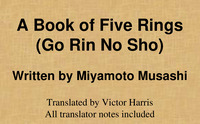
A Book of Five Rings
2025-08-22
While the actual combat advice is likely outdated, if for no other reason than modern guns usurping swords, many of the positions advocated for can be reapplied to other areas of life. The ground ring teaches that you should build your life on a solid foundation made up of focus, practice, intent, and lacking distractions. The water ring teaches that you should be fluid in your life, adjusting yourself to your environment, but still remain strong as even the slowest trickle of water can still carve out the deepest canyon. The fire ring is the least useful in modern context since it is heavily focused on actual combat, but you might draw inspiration to maintain your focus and practice in a diligent manner. The wind ring teaches that you should not be set in your ways and that you can always learn from alternate methods - know thy enemy - while the void ring reminds you that the way (learning, living) is not the means but the end.
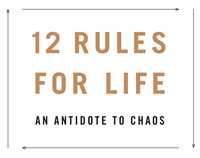
12 Rules for Life - An Antidote to Chaos
2025-08-19
Peterson uses meandering stories and exceedingly disconnected examples to make cases for his rules. He doesn't hide his literary slant and it feels like he is writing to show off his vocabulary and force his voice through the pages. That said, the rules are reasonable and would almost certainly provide a good starting point for anyone, but particularly young men, that might feel unmoored in today's social and political world. On one hand he makes a lot of calls back to biblical references, which in my bias opinion is a good foundation for rules for life, but on the other he regularly uses the trope of 'Hitler bad' (to his credit he also points out Lenin, Stalin, and Mao as well) which feels exceedingly weak in modern arguments. Overall I would say that while you might find the book useful it is quite a slog to get through if you are looking to get right to the point, but that might be a benefit to others that want to take their time and read some subjectively interesting stories while slowly absorbing the 12 rules.
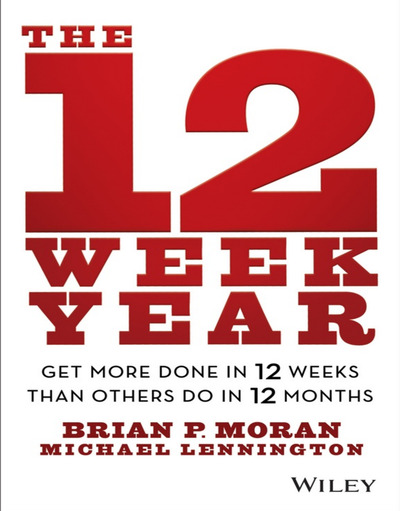
The 12 Week Year
2025-07-31
There isn't anything groundbreaking here and is little more than a way to focus on quarterly progress (their 12 week 'years') instead of annual progress. While nothing new, the system is good for keeping on track since you can reasonably plan 12 weeks whereas trying to plan 52 would be all but impossible. By having weekly and quarterly feedback of the (sub) goals you are striving to accomplish you get more and faster feedback. The authors make use of, but not as strictly, the time boxing or time blocking system I read about in Indistractable. Overall I think the 12 week year concept is little more than a gimmick, but the idea of shorter 'goal periods' that can produce feedback and be easier to forecast are solid strategies for accomplishing your goals.
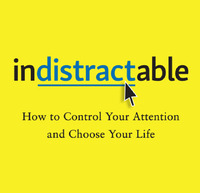
Indistractable
2025-07-25
The idea of timeboxing sounds very appealing to me and though I have tried to use it several times (and am trying again now), I always end up back in my basic monthly tasks I keep in a spreadsheet. Beyond timeboxing, the book has a lot of useful tips on identifying and understanding internal and external triggers that evoke some kind of emotion in you that ultimately leads to you getting distracted. Once you have a decent grasp of what your triggers are - and how you are likely avoiding pain instead of chasing pleasure - you can start to restructure your life to block out certain things at certain times. There is a lot of talk about technology and the author makes a solid case that it isn't the tech that is distracting us, it is the content delivered by said tech (and this has existed for generations - tv, radio, and even books were once blamed as distractions). Towards the end it feels a little repetitive, but in this part the author shows that the techniques learned can be reapplied to children in a bid to give them more agency, more motivation, and less distraction in their lives as well.
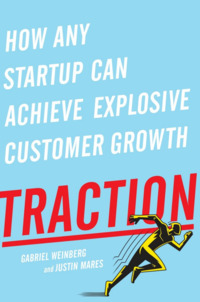
Traction - How Any Startup Can Achieve Explosive Customer Growth
2025-07-19
The first 5 chapters lay out the idea of how there are different channels that can be used to grow your business. There are 19 different channels put forth and a then you are presented with a plan for how to choose which to pursue and how you should be able to quickly and cheaply determine if a given channel is right for your business. The bulk of the book is going into detail, with each chapter deep diving into a given channel and also containing some interview-like nuggets of wisdom from someone who has successfully used said channel. As of my reading the book is 10 years old and can show its age in some places, but the overall and especially the offline strategies are still viable today even if you might need to massage them here and there to make them work. For my business, a few strategies jumped out and a few looked outright terrible, but the knowledge of what is out there for future possibilities is still valuable even if I don't intend to use those channels today.
Ai
Algorithms
Animals
Apache
Army
Art
Artificial-Intelligence
Bash
Bitcoin
Boycott
Business
Cia
Communication
Computer
Conspiracy-Theory
Creativity
Css
Culture
Cybernetics
Database
Demographics
Desk
Diabetes
Diet
Docker
Drugs
Eclipse
Economics
Education
Electronics
Encryption
Ergonomic
Evolution
Family
Fiction
Firefox
Flask
Fpga
Furniture
Games
Garden
Git
Godot
Graph
Gui
Habits
Hacking
Hardware
Health
Hiking
History
Html
Immigration
Java
Json
Keto
Lgbt
Linux
Machine Learning
Marketing
Math
Matplotlib
Media
Melatonin
Military
Motivation
Music
Neo4j
Notes
Numpy
Occult
Oligarchy
Pedophilia
Permaculture
Philosophy
Physics
Politics
Posture
Programming
Propaganda
Protest
Psychology
Psyop
Python
Python"
Rabbits
Regex
Religion
Research
Sci-Fi
Scipy
Sleep
Social
Software
Sqlite
Suicide
Technology
Time-Management
Travel
Vhdl
Vim
Waterfall
Woodworking
Writing